Showing posts with label Writing Advice. Show all posts

Tuesday, June 13, 2017

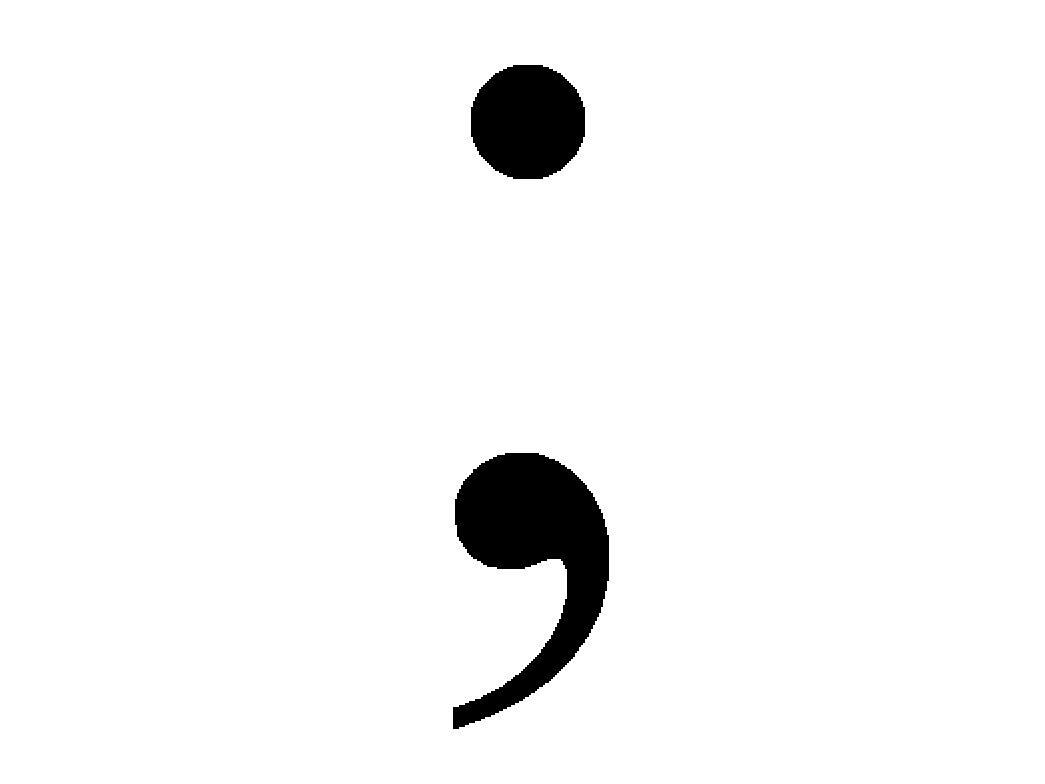
Punctuation 101: The Semicolon

Welcome to the first post in my new "Punctuation 101" series! I've decided to kick off the series with what used to be my least favorite punctuation mark. However, after taking a surprisingly fun grammar class, I have learned to appreciate the semicolon.

As you all know, I read A LOT. And in my reading, I've found that a lot of writers avoid using the semicolon, or they use a comma when they should actually be using a semicolon. I think part of the problem may be that a lot of people do not really understand what the purpose of the semicolon is or how to properly use it in their writing.

If you are one of these befuddled folks who are mystified by the semicolon, have no fear! This post will explain all you need to know about the semicolon.

The semicolon is a very handy punctuation mark. It can separate clauses, emphasize relatedness, clarify lists, and add variety to your writing.

So when exactly should you use a semicolon? There are three possible uses.

1) In a sentence with two independent clauses not linked by a connecting word. 
Basically, if both parts of your sentence could stand alone as their own sentences, then they are independent clauses, and you can link them without using a word like "and" or "but" or "so" by using just a semicolon. These sentences should also be closely related or of equal emphasis; the semicolon helps to visually show that these sentences are closely connected.

Correct: The weather was terrible that morning; the sky was hidden behind dark clouds and thunder rumbled in the distance.
This sentence is correct because the semicolon is linking two related independent clauses and there is no connecting word.

Incorrect: The dog drooled in anticipation as he watched the burger flip in the air; the Robertson's had purchased a new car.
While this sentence does have two independent clauses and no connecting word, a semicolon should not be used in this case because the two clauses are unrelated.

Incorrect: The gown was exquisite; and she looked incredible wearing it.
This sentence is incorrect because there is a connecting word. To fix this sentence, you could remove the "and" or use a comma instead of a semicolon.

2) In a sentence with two independent clauses and a conjunctive adverb or a transition. 
What are conjunctive adverbs you ask? It's just a fancy name for adverbs that link independent clauses. However, therefore, moreover, nevertheless, otherwise, consequently, etc. are all conjunctive adverbs. Transition words include for example, in addition, on the other hand, in fact, etc.

Correct: Julia had a traumatic experience involving the circus when she was a little girl; in fact, that childhood trauma has left her with a permanent fear of clowns. 
This sentence is correct because both halves of the sentence could be their own sentences (independent clauses), the clauses are related, and there is a transition.

Incorrect: The pasta is disgusting but the chicken; however, is excellent.
This sentence is incorrect because the part of the sentence after the semicolon is not an independent clause. In this case, "however" is working as a transitional word, not a conjunctive adverb, and the semicolon should be a comma.

3) To help clarify and organize a list or series when individual items in the list/series already use commas. 

Correct: Squeezed into the small tent with me are Sarah and Beth, my best friends; Julie, Sarah's cousin; and Mr. Woofus, who wouldn't stop whining until we let him in.

Correct: San Francisco, California; New York City, New York; and Miami, Florida are all famous cities in the United States.
The two sentences above are correct because they are both lists that already use commas. The semicolons help to organize and separate the the list items.

Incorrect: The lunch menu includes a side salad; sandwich; drink; and cookie.
This sentence uses semicolons incorrectly because there are no commas already being used. This list only needs commas, not semicolons.

If the list gave different options for the menu, then you could use semicolons. For example, the lunch menu includes a side salad; your choice of chicken, ham, or vegetarian sandwich; a water, juice, or soda; and a cookie or brownie.


So there you have it! All the information you need to know about the handy dandy semicolon and how to use (and not use) it in your writing. Go forth and enjoy adding the semicolon to your punctuation toolbox.

Saturday, March 4, 2017

How to Give Constructive Feedback


While most of the advice I give on this blog is geared toward helping writers, I decided to switch things up a bit today. This post is for anyone who helps writers by reading their work and giving feedback. We've probably all gotten well-meaning, but bad advice at some point in our lives. Writers also get a lot of well-meaning but not useful or un-helpful feedback about their work.  If you are someone who helps other authors as an editor, beta-reader, or a general writing buddy, check out the tips below to make sure you are giving the best feedback possible.

To begin, lets review the different types of editing. There are many types of editing and they can be called different names or defined differently depending on where you look or the industry. For simplicity, I've described the three main types of editing below:
  1. Substantive/Developmental Editing - I think of this type of editing as "big picture" editing. At this level, you are looking for problems of organization, coherence, logical consistency, etc. Are there plot holes, scenes that don't makes sense, key information that seems to be missing, or characters acting, well, out of character? 
  2. Copy/Line Editing - In copy or line editing you are taking a closer look at the text. This level of editing includes checking for errors in grammar, punctuation, style, word usage, repetition, etc. 
  3. Proofreading - This is the last step in the editing process and involves looking for any typos or minor mistakes that might have been missed earlier on in the writing/editing process. You might also look for formatting errors. I find that it helps to read the text aloud at this stage as your brain is less likely to skip over errors when you have to say each word. 
As an editor/beta reader/writing buddy, you may be doing any combination of the above three types of editing. If it makes you feel uncomfortable to point out errors in a writer's work for whatever reason, remember that you are not insulting the writer when you find errors or saying that their writing is bad. If you've been asked to read something and give feedback, it is your responsibility to help the writer produce their best work. By pointing out errors, you are giving the writer a chance to not only improve their work, but also their writing skill. 

While you are always on the lookout for errors and things that need correcting, I believe it is important to balance constructive feedback with positive feedback. Let the writer know what needs to be fixed, but also what they are doing well and that they should keep doing. 

Lastly, when giving feedback, it is crucial that your comments be specific and clear. You should explain what is working or not working and why. Saying "this is good" or "this is bad" doesn't give the writer much to go on. Try rather to say, "I like this dialogue because it sounds natural and flows well" or "This dialogue sounds unnatural because the character uses slang that is not from the time period." If you have a suggestion that could be a possible solution, go ahead and offer it, but remember you are offering a suggestion that the author can choose to use or not. For example, if an author uses the word "great" so frequently that it becomes obviously repetitive, you might point out, "You use 'great' very often. Try using synonyms like 'excellent' or 'impressive' to add variety to your writing." 

That's all for now folks! I wish you luck as you go forth and provide the best possible feedback to every writer you help. 


Friday, January 20, 2017

How to Bust Through Writers Block

Unless you are one of the very few and very lucky writers out there who have never suffered from writers block, this post might be helpful to you. Below are my top 3 suggestions to help you bust through writers block.
  1. Did you plot out your story/book? No? Then perhaps consider trying it out. While some writers like to "go with the flow" and see where their writing takes them, this doesn't work for everyone every time. Imagine your story is a road trip. You've got the starting point (your introduction) and your characters are travelling to some destination (the conclusion) and along the trip there are some pit-stops and detours (which makes the journey interesting). One possible reason for a block is that the road trip was not well planned. Your characters went to the cartoon museum first when they should have done that after visiting the nation's oldest bookstore, and then, because they lost time back-tracking, they skipped the giant ball of yarn, so the road trip was a total flop. Hmmm... maybe I should have gone with a different analogy... Anyways, the point is that sometimes a block is caused by missing or incorrectly ordered scenes which block the flow of the plot. If you plot out your story first, you can plan out the scenes to create the best road trip ever. 
  2. Step back and take a break. Whether this is from the book entirely or from a particular chapter or scene depends on what you feel you need. Sometimes putting too much pressure on yourself stifles your creative energy. Or looking at the same thing for too long gives you tunnel vision and prevents you from seeing other possibilities. Give yourself a break. Work on another scene or chapter, or maybe do some fun writing exercises to get your creativity flowing again. Then, go back to where you were stuck and try again. 
  3. Do you have a writing buddy or buddies? Support networks are important. Not everyone can go solo all the time. Maybe you need isolation to get into your writing "zone," but when the writers block isn't going away, it's important to have a person or people that you can bounce ideas off of or that can read your work and give you honest, constructive feedback. Emphasis on constructive! Your BFF, significant other, or well-intentioned neighbor may love and support your writing, but that doesn't mean that they will be able to give you helpful feedback and advice, so choose wisely. Having a writing buddy or buddies who you can talk to about your block and where/why you are stuck is great because they will bring different perspectives and fresh insight. They might see the reason for your block when you can't. 
Do you have any other ideas for how to beat writers block? Great! Please comment and share what works for you. 

Did one of the tips above help you get through your block? Fabulous! Feel free to comment and share your experience.